Skip to content
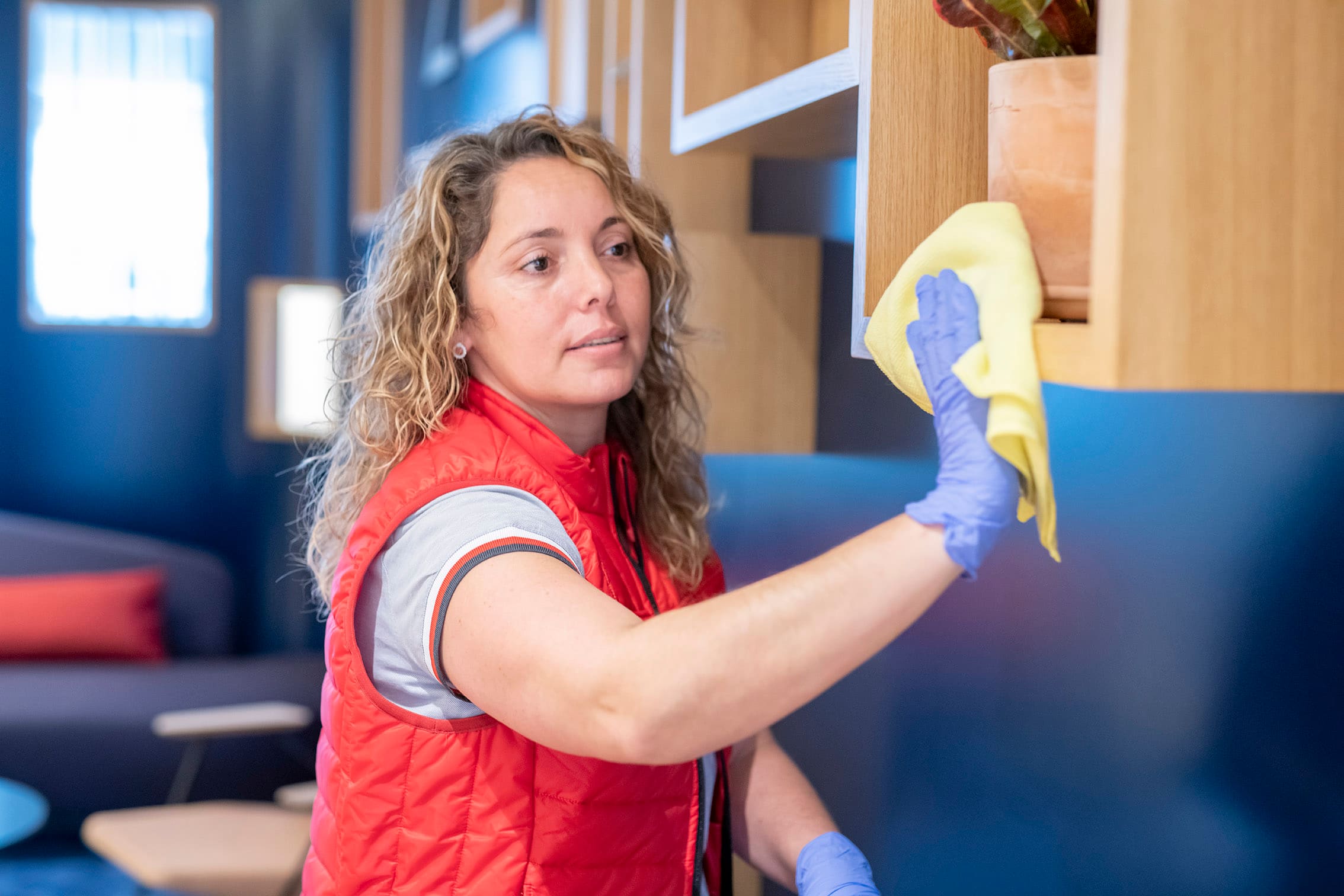
GSF team member performing cleaning in a hospitality / commercial environment.

Commercial cleaning

Clean, welcoming spaces aligned with your building standards.

Day-to-day and specialized commercial cleaning for offices, buildings, and demanding environments — in Quebec and Ontario according to contracts — stable routines with nearby supervision.

Common challenges

  • Inconsistent quality across shifts and sites
  • Occupant complaints related to cleanliness
  • Need for clear standards and field follow-up
  • Team turnover that erodes consistency of delivery
  • High-traffic zones that degrade long before the day ends
  • Difficulty adapting the service when occupancy changes

What the service aims for

  • Clean, presentable environments
  • Stable routines with nearby supervision
  • Adjustments to your occupancy schedules
  • Visible priorities handled first — reception, washrooms, circulation
  • A written standard per zone that survives a substitution

Our core expertise

Commercial cleaning is GSF’s founding trade, and it remains the centre of gravity of what we do in Quebec. Keeping a building is not simply cleaning it: it requires teams who know the site, written standards per zone, and supervision that actually walks the floors. The cleanliness a tenant, an employee, or a visitor perceives is built on regularity — not on one well-executed visit.

What building managers actually deal with

The requests that reach us look remarkably alike from one portfolio to the next: the service started well, then consistency eroded. The causes are rarely dramatic — a standard that was never written down, a substitution nobody briefed, a zone forgotten because it belonged to no one.

  • Expectations understood differently across shifts or floors
  • Substitutions starting from scratch because instructions were never passed on
  • Border zones (docks, service stairs, indoor parking) with no clear owner
  • Complaints handled one by one, without correcting the routine itself

How we read a building

We start by looking at the building the way your occupants experience it: where they enter, what they see first, which zones degrade fastest. That reading produces an order of priority, then a standard per zone — frequency, expected result, timing. Exact scope and follow-up arrangements remain defined in the agreement.

  • Site walkthrough and reading of occupancy journeys
  • A written standard per zone rather than one global task list
  • Intervention windows matched to real occupancy
  • A start-up checkpoint, then adjustments documented with you

Day-to-day cleaning

This is the backbone of the service: the same gestures, in the same places, with the same expected result. We favour a routine that reads clearly — one the regular team and a substitute can both follow — over a pile of instructions nobody sustains over time.

  • Common areas, lobbies, and visitor journeys
  • Offices, meeting rooms, and food areas within scope
  • Washrooms: cleaning, restocking, and visual checks
  • Circulation areas, stairs, and frequently used touchpoints

Specialized work

Some operations do not belong to the daily routine: they need equipment, preparation, and often a window outside occupancy. They are planned ahead, separately from the routine, and confirmed site by site under the agreement.

  • Deep care and restoration of floors according to their material
  • Care of carpets and circulation textiles
  • Interior glazing reachable without specialized access equipment
  • Post-construction or post-reconfiguration clean-up when the agreement calls for it

High-traffic zones

A main entrance, an elevator, or a lobby washroom does not behave like a closed office: it degrades during the day, precisely when the building is most looked at. We treat those zones as a subject of their own, with visits positioned during the day rather than a single end-of-service pass — within the limits of the agreed plan.

  • Identifying the zones that degrade fastest in your building
  • Maintenance visits positioned during occupancy when the plan allows
  • Particular attention to outdoor / indoor transitions in season
  • Frequencies tuned to what the field actually shows

Demanding environments

Many buildings include spaces more sensitive than the rest: a treatment room in a service centre, a laboratory on an industrial site, a controlled-access zone. We work there according to the site’s written instructions, in the zones you authorize, with teams informed before their first visit. This page claims no sterile qualification, no sector accreditation, and no proprietary protocol: the applicable framework is the one you define.

Our approach to quality

Quality follow-up rests on three simple things: a written standard per zone, supervision visits on site, and a clear channel to raise a gap. Findings are discussed with you and turned into routine adjustments rather than promises. We do not publish satisfaction scores, compliance rates, or unverified performance indicators; follow-up and reporting arrangements are set out in the agreement.

Responsible practices

We work to keep the day-to-day footprint of the service down: controlled product dosing, equipment maintained rather than replaced, waste sorted according to the facilities available on site, and avoidable consumables reduced. Product, equipment, and frequency choices are discussed with you in light of the building’s constraints. Documented management systems and company certifications are listed on Our commitments; no service-level eco-labelling is claimed here.

Offerings

According to site needs and the agreed scope.

  1. 01Daily cleaning of common areas, offices, and washrooms
  2. 02Periodic floor and surface care according to the agreed plan
  3. 03Occasional specialized work according to site needs and the agreed scope
  4. 04Accessible interior glazing when the agreement calls for it
  5. 05Basic supply stocking and follow-up
  6. 06Follow-up on visits and requests as set out in the agreement
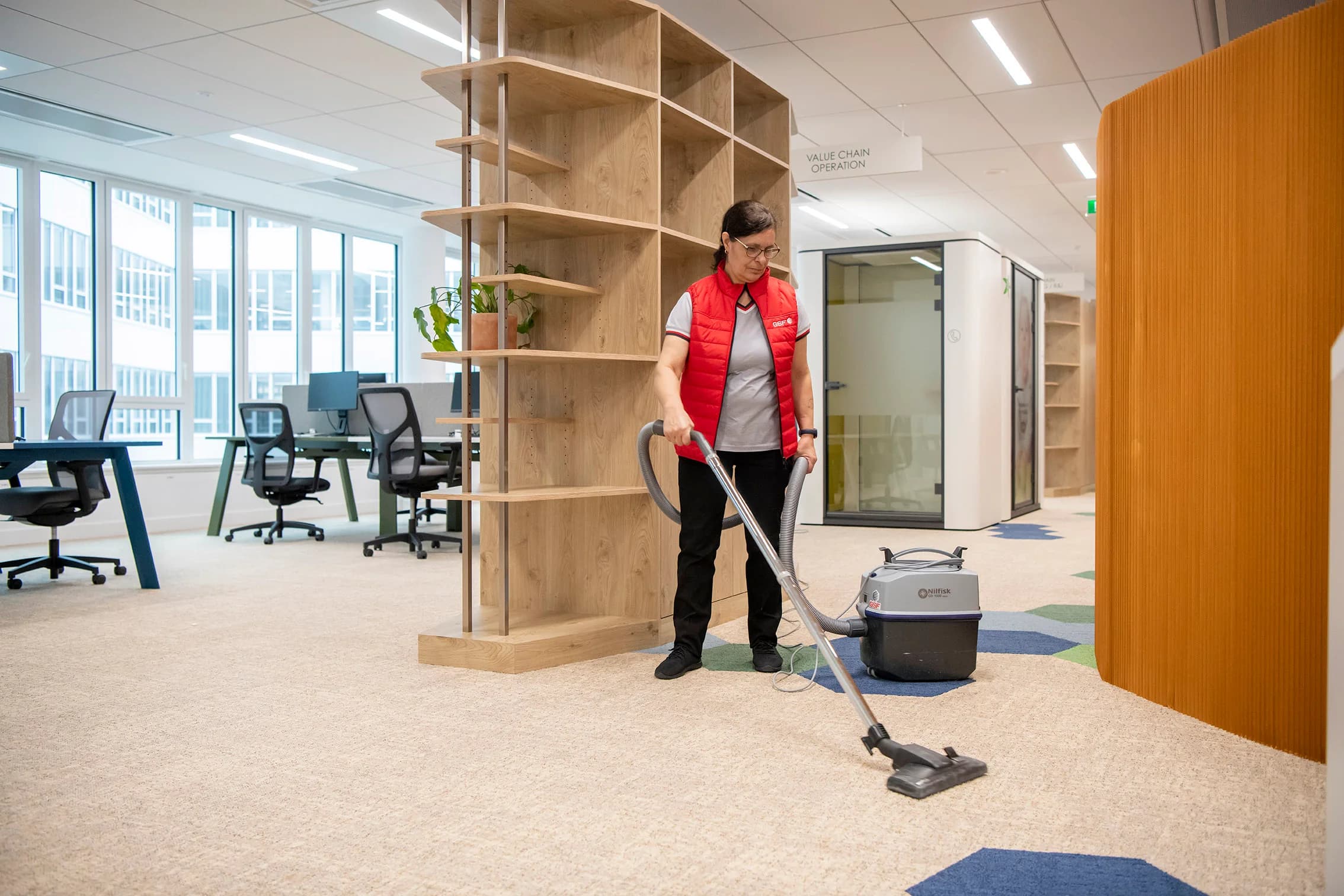
GSF team member vacuuming in an office environment — generic operational imagery.

Method

We define the scope with you, train teams, supervise delivery, and adjust based on on-site feedback.

  1. 01

    Scope of work

    Clarify standards, frequencies, and priority zones with you.

  2. 02

    Teams

    Train and deploy teams close to your sites.

  3. 03

    Supervision

    Supervise delivery and keep routines stable.

  4. 04

    Adjustments

    Adapt service based on field feedback and your calendars.

What you gain

  1. 01

    Supervised teams close to your sites

  2. 02

    Service standards clarified when we start

  3. 03

    A nearby contact for adjustments

  4. 04

    A routine that reads clearly and holds through absences or substitutions

  5. 05

    High-traffic zones treated as a distinct subject

  6. 06

    A plan that follows real occupancy rather than a fixed calendar

Related sectors

These environments often rely on this service. Operating context changes priorities.

Need more than one trade?

Cleaning, technical, and associated services can be coordinated through multiservices — one contact, a scope defined with you.

Professional mowing equipment in use during a GSF outdoor maintenance operation.

Common questions

GSF Canada

Let’s talk about your site

Describe your building and needs. We’ll clarify scope with you.